

Emergency Dentist of Austin
Bitten Lip, Tongue, or Cheek: How to Stop the Bleeding at Home
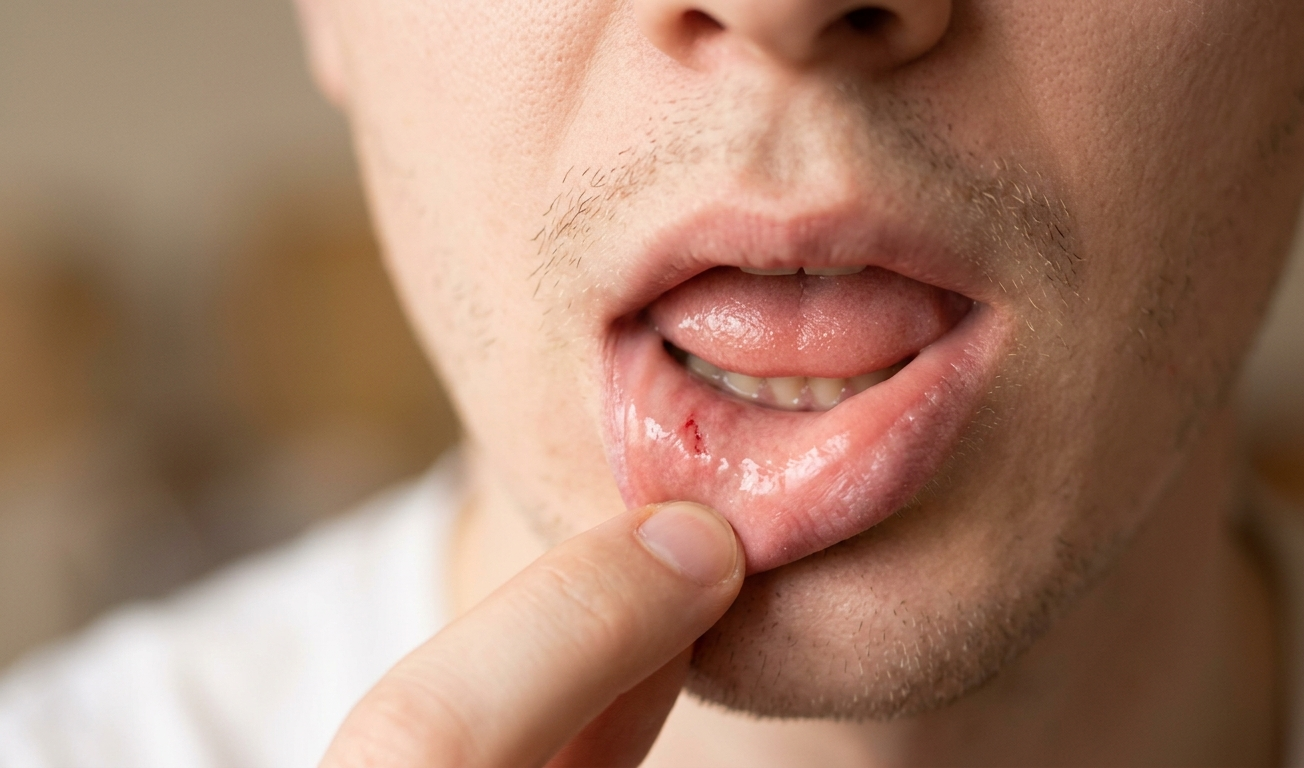
Most mouth bleeding stops with firm, continuous pressure for a full 10 to 15 minutes — no lifting the gauze to check. Use clean gauze or a damp washcloth, press directly on the cut, and hold a cold compress against the outside of the face at the same time.
Mouth injuries bleed dramatically. That is normal and it is not a measure of how bad the cut is. A small nick on a lip can produce a genuinely alarming amount of blood.
If bleeding continues past 15 minutes of proper pressure, call Emergency Dentist of Austin at (512) 961-6200.
Key Takeaways
- Press for 10–15 minutes without peeking. Lifting the gauze restarts the clot from zero.
- The amount of blood is misleading. Saliva dilutes it, so a minor cut looks like a major one.
- Stitches are for gaping edges, cuts across the lip border, tissue flaps, or anything over half an inch.
- Check the teeth too. The same impact often chips a tooth, and a missing fragment can lodge in the lip.
Why Does a Bitten Lip or Tongue Bleed So Much?
Quick answer: The mouth has an unusually rich blood supply and no way to hold a clot still. Saliva also dilutes blood and spreads it, which makes a small cut look far worse than it is.
Four things are working against you at once:
- Dense blood supply. The lips, tongue, and cheeks are fed by large branches of the facial and lingual arteries. There is far more blood flowing through this tissue than through skin of the same size.
- Saliva dilutes and spreads it. A few drops of blood mixed into saliva can fill the mouth with pink fluid. What looks like a cupful is usually a fraction of that.
- The tissue will not stay still. Talking, swallowing, and the tongue's constant movement tear off clots as fast as they form.
- It is warm and wet. Clots form more slowly in a moist environment than they do on dry skin.
None of this means the injury is serious. It means the mouth is bad at looking calm.
The reassuring flip side: the mouth also heals faster than almost any other part of the body. Most soft-tissue cuts inside the mouth close over within three to seven days.
What Is the Correct Way to Apply Pressure?
Quick answer: Place clean gauze or a damp washcloth directly on the cut, press firmly and continuously for 10 to 15 minutes, and do not lift it to look. Add a cold compress to the outside of the face at the same time.
The single most common mistake is checking too early. Every peek at the two-minute mark strips off the clot that was forming and sets the clock back to zero.
Follow this in order:
- Wash your hands.
- Sit the person upright, leaning slightly forward so blood drains out rather than down the throat. Do not tip the head back.
- Rinse once, gently, with cool water to see where the cut actually is. Do this once, at the start — not repeatedly.
- Place clean gauze, a damp washcloth, or a clean cloth directly over the cut. Paper towel works if that is all you have.
- Press firmly and hold. For a lip or cheek, pinch between thumb and finger from both sides. For a tongue, press the gauze against the roof of the mouth or hold the tongue gently in the gauze.
- Set a timer for 10 minutes. Do not lift, look, or adjust.
- Cold compress on the outside of the cheek or lip at the same time — 15 minutes on, 15 off.
- After 10 minutes, check once. If it is still bleeding, apply fresh gauze and hold another full 10 minutes.
Lip vs. Tongue vs. Cheek: Does It Change What I Do?
Quick answer: The pressure technique is the same everywhere, but lips bleed the most visibly, tongues bleed the most stubbornly, and cheek bites are the most likely to keep re-injuring themselves.
The cheek trap is worth knowing about. A bitten cheek swells, the swollen tissue then sits between the teeth, and it gets bitten again at the next meal. This can cycle for days. Chew slowly and deliberately on the opposite side until the swelling drops.
Does This Cut Need Stitches, or Will It Heal on Its Own?
Quick answer: Most mouth cuts heal without stitches. Get it assessed if the edges gape open, the cut crosses the lip border, there is a flap of loose tissue, or it is longer than about half an inch.
This is the comparison most people actually need, so look at the cut carefully once bleeding is controlled.
Why the lip border matters so much. The vermilion border is the sharp line between the coloured lip and the surrounding skin. The eye is extremely good at spotting even a one-millimetre misalignment there. A cut crossing that line should be assessed within a few hours so the edges can be lined up precisely — this is the one location where "it'll heal fine" often does not apply cosmetically.
Dr. Tarsem Lal, DDS assesses and repairs intraoral lacerations regularly, including the weekend run of injuries from the youth sports fields around North Austin, where a knee to the mouth in a Saturday soccer or football match is a routine reason to walk in.
Did the Same Impact Damage a Tooth?
Quick answer: Check every time. A blow strong enough to cut the lip is often strong enough to chip, loosen, or move a tooth, and adrenaline will hide it for hours.
Once bleeding is controlled, run through this in under a minute:
- Look at every front tooth for chips, cracks, or rough edges.
- Run a clean finger or tongue along the biting edges.
- Close the teeth together slowly. If one tooth touches before the rest, it has moved.
- Push very gently on the front teeth. Any looseness in an adult tooth needs same-day attention.
- Account for missing pieces. If a chip is missing and you cannot find it, it may be embedded in the lip.
⚠️ A missing tooth fragment can hide inside the lip. This is common after a face-first fall and easy to miss, because the entry wound seals over. A buried fragment causes infection weeks later. If a piece of tooth is unaccounted for, tell us — a quick soft-tissue X-ray settles it.
If a tooth came out completely, or is now loose or out of line, those are separate emergencies with their own time limits. Call us straight away and say so.
When Should I Stop Waiting and Come In?
Quick answer: Come in if bleeding continues past 15 minutes of firm pressure, the cut meets any of the stitch criteria, or a tooth was damaged. Go to an emergency room instead for breathing difficulty, uncontrolled bleeding, or head injury signs.
Anyone on blood thinners, or with a bleeding disorder, should call sooner rather than later — the 15-minute rule is less reliable for you.
How Do I Look After It for the Next Few Days?
Quick answer: Rinse gently with warm salt water after meals starting the day after the injury, eat soft cool foods, and keep an eye out for signs of infection.
Do:
- Warm salt-water rinses after eating, from day two (half a teaspoon in a cup of warm water)
- Soft, cool foods — yogurt, smoothies, ice cream, scrambled eggs, mashed potato
- Cold compress on the outside for the first 24 hours
- Ibuprofen or paracetamol as directed on the packet
- Keep brushing the teeth, gently avoiding the cut
Avoid:
- Salty, spicy, acidic, or crunchy food — chips and citrus juice are the usual culprits
- Hydrogen peroxide or alcohol-based mouthwash
- Poking or stretching the cut to inspect it
- Very hot drinks
- Contact sports until it has healed
Call us if you notice: increasing pain after day three, spreading redness or swelling, pus, fever, a bad taste that will not rinse away, or a cut that has not begun closing after a week.
Frequently Asked Questions
I bit my tongue and the bleeding won't stop. What do I do? Press clean gauze firmly against the cut for a full 10 to 15 minutes without lifting it to check. If it is still bleeding after a second full round of pressure, call us at (512) 961-6200.
How long should a bitten tongue bleed? Most tongue bleeding stops within 10 to 15 minutes of proper, uninterrupted pressure. Bleeding that continues beyond that, or restarts every time pressure comes off, needs to be looked at.
Do mouth cuts need stitches? Most do not, because the mouth heals quickly on its own. Stitches are usually needed for gaping edges, cuts longer than about half an inch, tissue flaps, or any cut crossing the lip border.
Can I put ice directly on the cut? Put the cold compress on the outside of the cheek or lip, not directly on the wound. An ice pop or ice chip held in the mouth is fine and often helps children more than a compress.
Why does my mouth still taste like blood hours later? Small amounts of oozing continue for a while and mix with saliva, which is normal. If you are actively spitting out red blood rather than tasting it, that is different and needs attention.
Should I use mouthwash on a bitten lip? Not a standard alcohol-based one — it stings badly and irritates healing tissue. Warm salt water is better, starting the day after the injury.
Do I need a tetanus shot for a mouth injury? Possibly, if the wound involved soil, gravel, or a dirty surface, or if it came from an animal. Tell us what happened and when your last booster was.
How long does a bitten cheek take to heal? Usually five to ten days, though swelling can make you bite the same spot again and restart it. Chew slowly on the other side until the swelling goes down.
When should I go to the ER instead of a dentist? Go to the ER for spurting bleeding, difficulty breathing or swallowing, loss of consciousness, or a suspected broken jaw. For cuts, tooth damage, and bleeding that will not settle, an emergency dentist is the right stop.
My child bit their lip and it's swollen. Is that normal? Swelling out of proportion to a small cut is very normal on lips, and usually peaks within 24 hours. Call us if the swelling is still increasing after two days or if your child will not drink.
Can a bitten lip get infected? It can, though it is less common than with skin wounds because saliva has natural antibacterial properties. Watch for increasing pain after day three, spreading redness, pus, or fever.
Do you take walk-in patients for this? Yes. We are open Monday, Friday, Saturday, and Sunday, 8am to 8pm, and see walk-in patients from Austin, Round Rock, Cedar Park, Georgetown, Leander, Kyle, Buda, Lakeway, Bee Cave, West Lake Hills, Hutto, Manor, Dripping Springs, Del Valle, Elgin, and Liberty Hill.
If It's Still Bleeding, Call Us
Take a breath. The volume of blood in front of you is almost certainly not telling you how bad this is. Sit upright, get clean gauze on the cut, press firmly, and leave it alone for a full ten minutes.
Most of the time, that is the whole treatment.
If bleeding continues past 15 minutes of firm pressure, call (512) 961-6200 and come to 1030 Norwood Park Blvd #324, Austin, TX 78753. Keep the pressure on during the drive.
Also call if the cut is gaping, crosses the lip border, or a tooth was damaged in the same impact. We are open Monday, Friday, Saturday, and Sunday, 8am to 8pm, and take walk-in patients throughout the day — no appointment needed for emergency dental care.
Read More
.jpg)
Emergency Tooth Extraction Cost in Austin, TX
.jpg)
Infected Tooth: Root Canal or Extraction in Austin, TX?
Read more.jpg)
Tooth Extraction on Blood Thinners: Austin, TX Guide
Read moreDon't Wait Out the Pain
