

Emergency Dentist of Austin
Knocked-Out Tooth: The Milk, Time, and Handling Rules That Decide If It Can Be Saved
If you are holding a knocked-out adult tooth right now, put it in cold milk. Milk keeps the tooth viable for roughly three to six hours, but the real target is much shorter: the best outcomes happen when the tooth is back in the socket within 30 minutes, and survival drops sharply after 60 minutes of dry time.
Better still, if you can, gently put the tooth back into its own socket immediately. That is the single most effective thing anyone can do at the scene.
Then call Emergency Dentist of Austin at (512) 961-6200 and drive straight in.
Key Takeaways
- Put it back in the socket if you can. If you cannot, use cold milk. Never plain water, never dry in a tissue.
- Under 30 minutes is the goal. After 60 minutes of dry time, the odds of long-term survival fall sharply.
- Touch the crown only. Never scrub, wipe, or dry the root, and never remove tissue clinging to it.
- Milk buys you travel time, not a day. Aim to be in the chair within an hour.
What Should I Do With a Knocked-Out Tooth in the First 60 Seconds?
Quick answer: Find the tooth, pick it up by the white crown only, and either place it straight back in the socket or drop it into cold milk. Then call ahead and drive in.
Work through this in order. Do not stop to research anything else.
- Find the tooth. Look on the ground, in the sink, or wherever the impact happened.
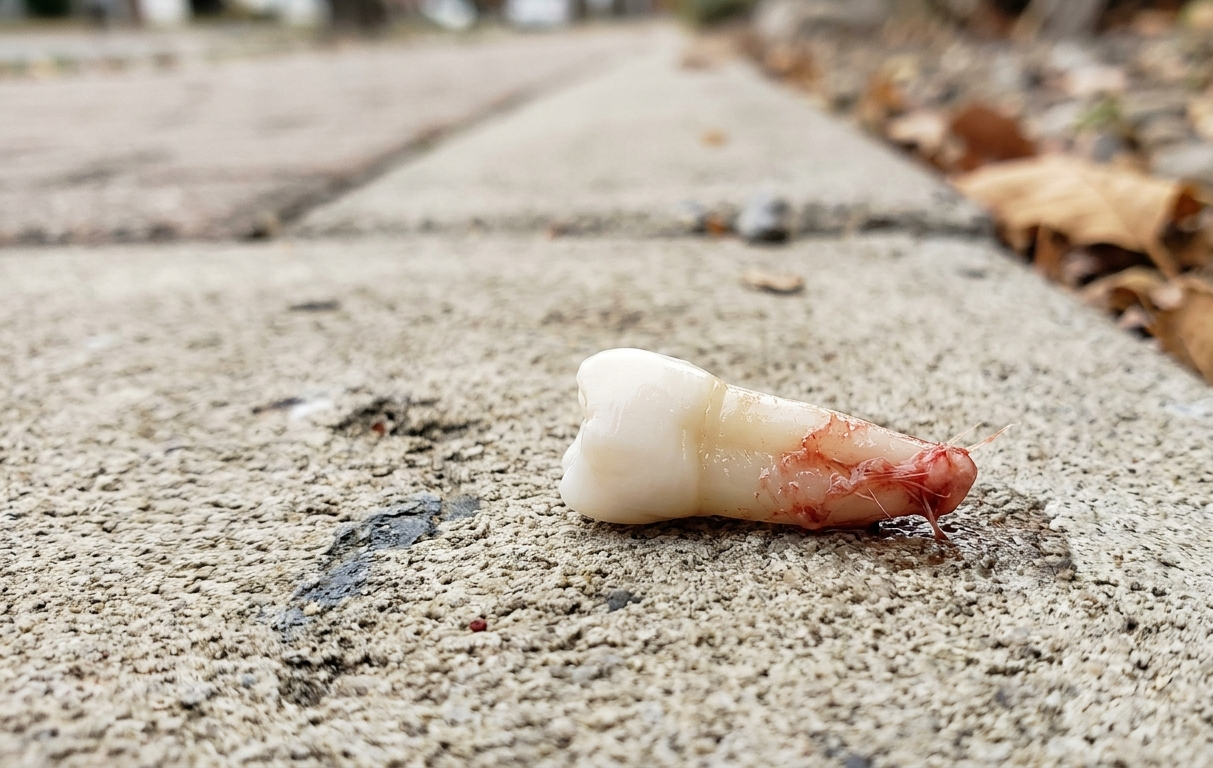
- Pick it up by the crown. The crown is the white chewing part you normally see. The root is the pointed end that was under the gum.
- Do not scrub it. If it is visibly dirty, rinse for no more than 10 seconds under cold milk, saline, or briefly under water. Do not use soap, a cloth, or a brush.
- Put it back in the socket if the person is calm enough and old enough to hold it in place. Bite gently on a clean cloth or a folded paper towel.
- If you cannot, use cold milk. Any plain cow's milk works. Cover the tooth completely.
- Call (512) 961-6200 while someone else drives.
- Control bleeding with firm pressure on the gum using clean gauze.
⚠️ Warning: do not replant a baby tooth. Putting a knocked-out baby tooth back can damage the permanent tooth forming above it. If you are not sure which one you are holding, bring it in and let us look. Baby teeth are smaller, whiter, and have short or partly dissolved roots.
Knocked-Out Tooth in Milk: How Long Does It Actually Last?
Quick answer: Cold milk keeps the root cells alive for about three to six hours. But that is a ceiling, not a plan. Replantation done within 30 minutes gives the best long-term result, and the prognosis worsens noticeably past the one-hour mark.
Milk is a holding tank, not a cure. Every minute the tooth spends outside the mouth, cells on the root surface are dying. Milk slows that clock down. It does not stop it.
The rule that matters: dry time is what destroys a tooth. A tooth that sat in a tissue for 40 minutes is in far worse shape than one that sat in milk for two hours.
Even past the six-hour mark, bring the tooth. There are things we can still do, and that decision belongs in the office, not on the roadside.
Why Are the Root Cells the Thing I Am Actually Trying to Save?
Quick answer: A thin layer of living cells called the periodontal ligament coats the root. These cells are what re-anchor the tooth to the bone. Save them and the tooth can reattach; lose them and the body treats the tooth as foreign.
Your teeth are not fused to your jaw. Each one is suspended in its socket by a fine, springy sling of tissue — the periodontal ligament, or PDL. It is the reason teeth have a tiny amount of give when you bite.
When a tooth is avulsed (the clinical word for knocked completely out), roughly half that ligament stays in the socket and half stays stuck to the root.
Those cells are fragile and exposed. They die from three things:
- Drying out. The fastest killer. Minutes matter.
- Scrubbing or wiping. This physically strips the cells off.
- Plain water. Water is not chemically similar to your body's own fluids, so it makes the cells swell and burst.
If enough of these cells survive, the ligament knits back together and the tooth becomes solid again. If they do not, the body slowly replaces the root with bone — a process called replacement resorption — and the tooth loosens or is lost years later.
That is why the handling rules seem fussy. They are not about cleanliness. They are about keeping a microscopic layer of tissue alive.
Milk vs. Water vs. Saliva vs. Saline: Which Storage Actually Works?
Quick answer: The socket is best. Cold milk is the best practical backup. Saline is next, then the patient's own saliva. Plain water and dry storage are the two options that actively destroy the tooth.
This is the comparison that decides most cases, because almost everyone reaches for water first.
If all you have is a convenience store on the way in, buy milk. That is a genuinely good outcome.
Under 30 Minutes vs. Over an Hour: What Changes?
Quick answer: Under 30 minutes, the goal is a tooth that reattaches and lasts decades. Past an hour dry, the goal shifts to keeping the tooth in place for as long as possible while planning what comes next.
Even in the second column, replanting buys time. In a growing teenager especially, keeping the natural tooth in place preserves the jawbone and the gum line for future options.
How Do I Hold the Tooth Without Ruining It?
Quick answer: Crown only, wet at all times, no scrubbing. Treat the root the way you would treat an open wound — because that is essentially what it is.
How Do I Put the Tooth Back In Myself?
Quick answer: Line it up the same way as the teeth beside it, press it in slowly and firmly with your thumb, and bite on a cloth to hold it. If it will not seat with gentle pressure, stop and use milk instead.
Reinsertion sounds intimidating. In practice, most people manage it.
- Rinse the socket gently if there is a visible clot. Have the person rinse their mouth with cold milk or saline, not water.
- Check the orientation. The flat, broad face goes forward. Compare it to the neighbouring tooth.
- Press slowly. Push down and in with a thumb until the tooth sits level with its neighbours. It should take firm, steady pressure — not force.
- Hold it there. Bite gently on clean gauze, a folded paper towel, or a clean cloth for the drive in.
- Do not force it. If it will not go, milk is a perfectly good second option. Nobody has failed here.
Do not attempt this if the person is unconscious, badly disoriented, very young, or has a suspected jaw or head injury. Those need medical assessment first.
What Happens Once I Get to the Office?
Quick answer: We confirm the tooth's position with an X-ray, seat it properly under local anaesthetic, and bond a flexible splint to the neighbouring teeth for about two weeks. Root canal treatment usually follows a week or so later.
Dr. Tarsem Lal, DDS has replanted and splinted avulsed teeth for patients arriving from all over Central Texas, and the sequence is well established. Because the practice sits on Norwood Park Boulevard in North Austin, just off the I-35 and US-290 interchange, most patients from Round Rock, Pflugerville, Hutto, and central Austin are here well inside that first hour.
The splint is deliberately flexible. A rigid splint holds the tooth too still, and a little movement actually helps the ligament heal.
Frequently Asked Questions
How long can a knocked-out tooth stay in milk? Cold milk keeps the root cells viable for roughly three to six hours. Aim to be seen within the first hour anyway, because milk slows cell death rather than stopping it.
Can I use almond, oat, or soy milk? No. Plant milks do not have the salt and protein balance that keeps the root cells alive. Use plain cow's milk, saline, or the patient's own saliva instead.
Should the milk be cold? Yes, cold is better than room temperature, because cold slows the rate at which cells die. Do not add ice directly to the tooth or freeze it.
What if I already put the tooth in water? Move it into milk immediately and come straight in. Water damages the root cells quickly, but the tooth is still very much worth bringing.
Can a knocked-out tooth be saved after 24 hours? Long-term reattachment is unlikely after that long, especially if the tooth was dry. Bring it anyway — replanting can still preserve bone and buy time for a permanent solution.
Does it hurt to have the tooth put back in? The area is numbed with local anaesthetic before anything is repositioned, so the procedure itself is not painful. Most patients report more discomfort from the original injury than from the treatment.
Will I definitely need a root canal? For a fully developed adult tooth, almost always, and it is usually started about a week after replantation. Teeth in children with roots still forming are sometimes able to keep their nerve.
Do I need a tetanus shot? If the tooth or wound touched soil, gravel, or dirty water, tell us and check when your last tetanus booster was. We will advise you at the visit.
What if I can't find the tooth? Come in anyway, and let us know it was not recovered. We will X-ray to make sure no fragment was pushed into the lip, gum, or socket, and discuss replacement options.
Should I go to the ER instead? Go to the ER first only if there is a head injury, loss of consciousness, uncontrolled bleeding, or a suspected broken jaw. Otherwise an emergency dentist is the right stop, because most ERs cannot replant or splint a tooth.
Is a knocked-out tooth an emergency if it doesn't hurt? Yes. Adrenaline masks pain after an injury, and the clock on the root cells runs regardless of how you feel.
Do you see patients from outside Austin? Yes. We treat patients from Round Rock, Cedar Park, Georgetown, Leander, Kyle, Buda, Lakeway, Bee Cave, West Lake Hills, Hutto, Manor, Dripping Springs, Del Valle, Elgin, and Liberty Hill, and we are open Monday, Friday, Saturday, and Sunday, 8am to 8pm.
Do This Now
A knocked-out adult tooth is one of the few dental problems where the next 30 minutes genuinely change the outcome. Get the tooth back in the socket or into cold milk, and start moving.
Call (512) 961-6200 right now and drive straight to 1030 Norwood Park Blvd #324, Austin, TX 78753. Tell us you are on your way with an avulsed tooth and we will have a room and an X-ray ready when you arrive.
We are open Monday, Friday, Saturday, and Sunday, 8am to 8pm, and walk-in emergency dentistry patients with a knocked-out tooth go to the front of the queue. If the tooth turns out to be beyond saving, we will talk you through emergency extractions and replacement options in the same visit — but that is a conversation for the chair, not the car.
Bring the tooth. Bring the milk. Call us on the way.
Read More
.jpg)
Emergency Tooth Extraction Cost in Austin, TX
.jpg)
Infected Tooth: Root Canal or Extraction in Austin, TX?
Read more.jpg)
Tooth Extraction on Blood Thinners: Austin, TX Guide
Read moreDon't Wait Out the Pain
