
Emergency Dentist of Austin
Tooth Driven Into the Gum: Why Intrusion Is Urgent Even When It Barely Hurts
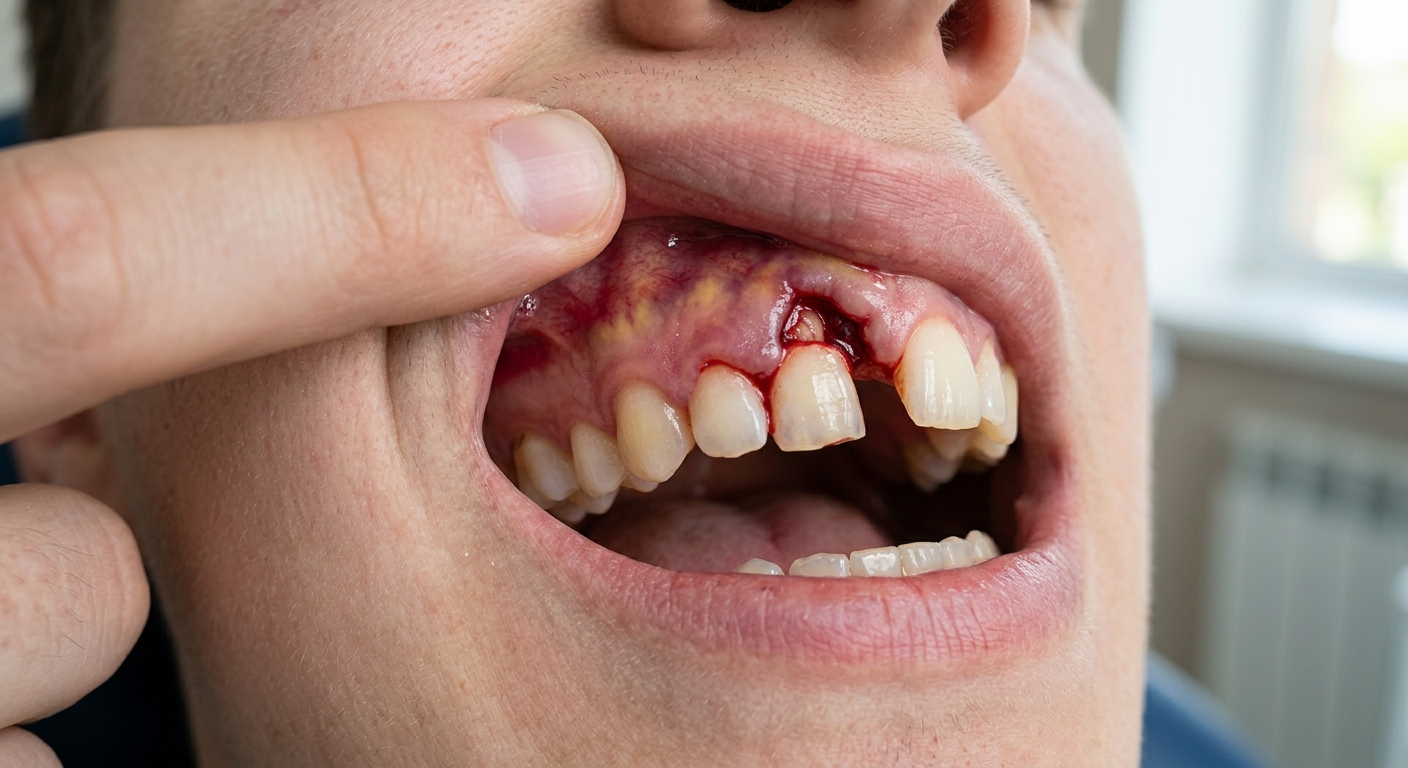
A tooth pushed into the gum after an impact is called an intrusion, and it needs a dental X-ray the same day even if there is almost no pain. The tooth has been driven up into the bone, crushing the ligament and the blood vessels that keep it alive. Because it is now wedged tight, it does not wobble and often does not throb, which is exactly why people wait.
That wait is the problem. Intrusion carries one of the highest complication rates of any dental injury, and the treatment window narrows within weeks. If a tooth now sits shorter than the ones beside it, call (512) 961-6200 today.
Key Takeaways
- An intruded tooth is driven up into the bone, not knocked loose. It feels solid and often hurts very little, which hides how serious the damage is.
- The nerve and blood supply at the root tip are usually crushed on impact. Most mature intruded teeth eventually need root canal treatment.
- Baby teeth and adult teeth follow opposite rules. An intruded baby tooth can damage the permanent tooth forming right above it.
- Waiting to see if it drops back down is a gamble. The tooth can fuse to the bone within weeks, after which it cannot be moved.
What does it mean when a tooth is pushed into the gum?
Quick Answer: Intrusion the clinical term is intrusive luxation is when a blow drives a tooth straight up (or down, in the lower jaw) into the jawbone. The tooth is not loose; it is jammed into a socket that has usually been fractured by the force. It looks shorter than its neighbours, or in severe cases it disappears from view entirely.
This happens most often to the upper front teeth, and most often from a direct, straight-on impact: a face-first fall, a knee or elbow to the mouth, a collision with a car dashboard, a playground bar.
The direction of the force is what makes intrusion different. A sideways blow pushes a tooth out of line and tears the ligament that hurts, bleeds, and is obvious. A straight-on blow drives the tooth deeper, compressing everything at once. There is nowhere left for the tooth to move, so there is little of the movement that normally produces pain.
⚠️ If a tooth appears to be missing entirely after an impact, do not assume it was knocked out. A fully intruded tooth can be buried in the bone and invisible. It can also be embedded in the lip, or inhaled. Any tooth that cannot be accounted for needs an X-ray to locate it.
Why doesn't an intruded tooth hurt much?
Quick Answer: Pain from a damaged tooth usually comes from movement and from pressure that has somewhere to go. An intruded tooth is locked into bone, so it does not move, and the pulp inside has often already lost its blood supply meaning the nerve may be dying rather than complaining. Low pain is a sign of the injury's severity, not its mildness.
Dentists notice this at the chair. Tapping a healthy tooth gives a dull, cushioned sound because the ligament acts as a shock absorber. Tapping an intruded tooth gives a high, hard, metallic note, because the ligament has been crushed and the tooth is now in direct contact with bone.
That single change tells an experienced clinician a great deal. Dr. Tarsem Lal, DDS and the team at Emergency Dentist of Austin see intrusive luxation regularly in both children and adults, and the assessment is the same either way: percussion test, mobility test, and an X-ray to measure exactly how far the tooth has moved and which way the root tip is pointing.
Is it intruded, chipped, or knocked out? How do I tell?
Quick Answer: Compare the injured tooth to the one next to it. If it sits shorter but the edge is intact, it is intruded. If the edge is broken but the height is normal, it is chipped. If it is longer, looser, or out of line, it is a different kind of luxation. All four need same-day care, but intrusion is the one people most often dismiss.
A useful home check: look straight into a mirror in good light, or take a photo of your child's smile and compare it to an older photo. Height difference is easier to spot in a picture than in a panicked moment at the sink.
What damage happens beneath the gum?
Quick Answer: Intrusion damages four things at once the blood supply at the root tip, the nerve inside the tooth, the ligament that holds the tooth in place, and the bone of the socket. Each one carries its own complication, and they can appear months apart.
Two of these deserve emphasis. Pulp death is the most common outcome in a fully formed adult tooth the blood vessels entering through the narrow root tip are usually severed on impact and cannot reconnect. Root resorption is the most dangerous, because it is completely painless and only shows on an X-ray. A root can be measurably shorter within a few months of an untreated intrusion.
Baby tooth vs. permanent tooth: why the rules are opposite
Quick Answer: With an intruded permanent tooth, the goal is to save it and bring it back down. With an intruded baby tooth, the goal is to protect the permanent tooth developing directly above it and sometimes that means removing the baby tooth rather than repositioning it.
The permanent tooth bud sits very close to the root tip of the baby tooth in front of it. When a toddler's front tooth is driven upward, that root tip moves toward or away from the developing tooth. Which direction it went is the whole question, and it can only be answered with an X-ray.
If the baby tooth has been driven into the developing tooth, the permanent tooth can erupt years later with white or yellow-brown marks on the enamel, a bent crown or root, or in the wrong position. These effects cannot be undone once they happen, but they can often be avoided by acting early.
This is why "he's fine, he stopped crying" is not a reason to skip the visit. Toddlers recover their mood quickly. The permanent tooth does not.
Will an intruded tooth come back down on its own?
Quick Answer: Sometimes but only in specific cases, and only under supervision. Young teeth with unfinished roots often re-erupt naturally within a few weeks. Fully formed adult teeth usually will not, and deeply intruded teeth almost never do. Waiting without an X-ray is a gamble, because you cannot see which category you are in.
Here is what is actually being risked during a wait-and-see period at home:
- Ankylosis. The crushed ligament can be replaced by bone, fusing the tooth in place. Once that happens the tooth cannot be moved orthodontically or surgically. In a growing child, the jaw keeps developing around the fused tooth and leaves it sitting low.
- Inflammatory resorption. A dead pulp left untreated triggers the body to dissolve the root from the outside. This can progress quickly and is painless.
- Infection. A necrotic pulp can become an infected one, at which point a straightforward problem becomes an urgent one.
- A closed window. Repositioning gets harder the longer the tooth stays where it is.
Supervised waiting is a legitimate treatment. Unsupervised waiting is not the same thing. The difference is an X-ray and a review appointment.
What are the treatment options?
Quick Answer: There are three paths — let it re-erupt naturally, move it back with orthodontic traction, or reposition it surgically. The choice depends on how deep the intrusion is and whether the root is fully formed. Root canal treatment is often added afterward for adult teeth.
On root canal treatment: in a fully formed adult tooth the pulp rarely survives an intrusion, so endodontic treatment is usually started a couple of weeks after repositioning rather than waiting for symptoms. Starting early is deliberate it stops the dead pulp from driving root resorption. That work is handled through our Emergency Root Canals service, often in the same course of care as the repositioning.
Younger teeth with open root tips are treated differently, because they can sometimes re-establish their own blood supply. That is one of several reasons a child's intrusion and an adult's intrusion are not managed the same way.
What does the timeline look like?
Quick Answer: The first appointment should happen the same day. After that, intrusion is managed over months, not days, because the complications that matter most appear late and silently.
Families across the Round Rock and Pflugerville corridor along I-35 often make this drive more than once the first visit is urgent, and the follow-ups are what actually protect the tooth. It is worth building them into the calendar from the start.
What should I do right now?
- Do not try to pull the tooth back down. It is wedged in bone, and forcing it causes more damage.
- Do not push on it or test it repeatedly to see if it moves.
- Rinse the mouth gently with cool water. Do not scrub the gum.
- Hold a cold compress against the outside of the lip, 20 minutes on, 20 minutes off.
- Give an anti-inflammatory pain reliever if appropriate, at the correct dose for age and weight.
- Switch to soft food and avoid biting on that tooth entirely.
- Take a photo of the tooth now, so any further movement can be compared later.
- Call (512) 961-6200 the same day for an X-ray — even if your child seems completely fine.
If any tooth or fragment cannot be found, say so when you call.
Blunt force impacts to the face rarely affect just the teeth they often involve soft tissue cuts and severe bleeding inside the mouth. If your injury includes cuts to your soft tissues, review our guide on how to stop bleeding from a bitten lip, tongue, or cheek at home before heading to the clinic.
Frequently Asked Questions
Is a tooth pushed into the gum an emergency if it doesn't hurt? Yes. Intrusion causes little pain precisely because the tooth is locked in bone and the nerve may already be dying. The lack of pain says nothing about the damage underneath.
How far can a tooth be pushed into the gum? Anywhere from a millimetre or two to completely out of sight. Depth is measured on an X-ray and is one of the main factors in deciding whether the tooth is monitored or repositioned.
Will my child's baby tooth grow back down? Often yes, over several months, but only if the X-ray shows the root tip moved away from the permanent tooth above. If it was driven toward the permanent tooth, removal is usually safer.
Can an intruded tooth damage the adult tooth underneath? It can. Possible effects include white or brown marks on the enamel, a bent crown or root, or the permanent tooth erupting late or in the wrong place. Early assessment reduces the risk.
How long can I wait before seeing a dentist? The same day is the target. The treatment window narrows over the following weeks as the ligament heals into bone, and once that happens the tooth can no longer be moved.
Why does an intruded tooth turn grey? Greying usually means the pulp inside has died after losing its blood supply. It often appears weeks to months after the injury and is a reason to be seen, not a cosmetic issue to cover up.
Does an intruded tooth always need a root canal? Not always, but a fully formed adult tooth very often does, because the blood supply at the root tip rarely survives. Young teeth with unfinished roots have a better chance of recovering on their own.
Can the tooth be pushed back into place straight away? Sometimes, depending on depth and root maturity. Shallow intrusions are often watched first, while deeper ones are repositioned surgically or moved gradually with orthodontic traction.
What is ankylosis, and why does it matter? Ankylosis is when the tooth fuses directly to the bone after the ligament is destroyed. The tooth then cannot be moved, and in a growing child it gets left behind as the jaw develops around it.
My tooth was intruded years ago and now hurts. Is that related? It can be. Old intrusions can lead to a slowly dying pulp, root resorption, or infection that only becomes noticeable much later. An X-ray will show whether the previous injury is the cause.
Are you open on weekends? Yes Monday, Friday, Saturday and Sunday, 8am to 8pm, which covers the hours when most general and paediatric practices around Austin are closed. We manage intrusive luxation in both children and adults.
The bottom line
A tooth driven up into the gum is one of the few dental injuries where how it feels tells you almost nothing about how serious it is. The real damage to the blood supply, the ligament, the socket bone, and in children the permanent tooth above is happening out of sight, and some of it becomes permanent within weeks.
Read More
.jpg)
Swollen Gums and Bad Breath: What's Causing Both in Austin, TX
.jpg)
Swollen Gums That Won't Go Away: What to Do in Austin, TX
.jpg)
Gingivitis vs Periodontitis: What Austin, TX Patients Should Know
Don't Wait Out the Pain
