
Emergency Dentist of Austin
Cracked Tooth Symptoms: Signs of a Hidden Crack in Austin, TX
Reviewed by Emergency Dentist of Austin Team. Last updated on 11/22/2026.
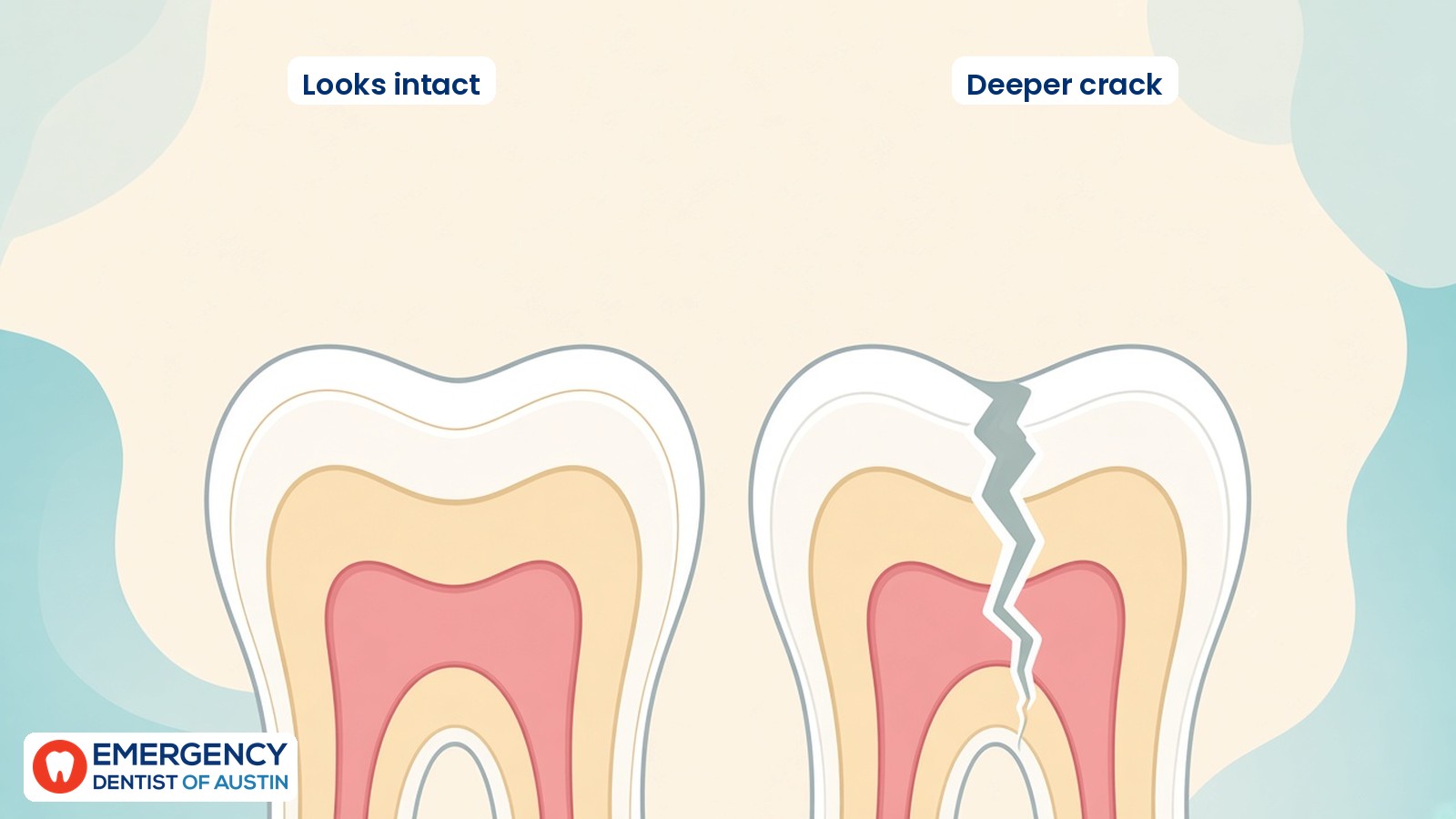
Cracked tooth symptoms often include a sharp pain when you bite or when you let go, plus sensitivity to hot or cold that comes and goes. The American Association of Endodontists notes that the pain may be erratic, and it can be hard to tell which tooth is causing it. A crack can be invisible, so you cannot know for sure until a dentist examines it.
If those signs sound familiar, our team at Emergency Dentist of Austin, at 1030 Norwood Park Blvd #324 in North Austin, can check the tooth and explain what it needs.
Short Answer
A cracked tooth often hurts for a moment when you chew or when temperature hits the tooth, then the pain fades. The tooth may look normal. That pattern is still worth an exam, because a crack can reach the inner tooth and lead to infection if it is left alone. Home care can make you more comfortable, but it does not close the crack.
Key Takeaways
- Pain on biting or on release, and on-and-off hot or cold sensitivity, are common cracked tooth symptoms.
- A crack may not show in the mirror or even on an X-ray, so you cannot know for sure until a dentist examines it.
- Rinse with warm water, use a cold compress, and see a dentist as soon as possible.
- Do not put aspirin on the tooth or gums. Swelling with trouble breathing or swallowing belongs in an emergency room.
Table of Contents
- What are the most common cracked tooth symptoms?
- Why does a cracked tooth hurt when you bite or drink something cold?
- Can a cracked tooth have no visible signs?
- What types of cracks cause different symptoms?
- What can you do at home until you are seen?
- When should you see a dentist or go to the ER?
- What does this look like for an Austin patient?
- Frequently Asked Questions
- References

What are the most common cracked tooth symptoms?
The most common signs are a sharp, brief pain when you chew, pain when you release the bite, and on-and-off sensitivity to hot or cold. The American Association of Endodontists notes that this pain can be erratic, may come and go, and can be hard to pin to one tooth. The ADA's MouthHealthy guide to top dental symptoms adds that a cracked or broken tooth may be invisible to the eye, and even to an X-ray, so pain when chewing is a reason to see a dentist.
According to Dr. Dudeen, a flash of pain when you bite is a classic reason to have a tooth checked for a crack.
Why does a cracked tooth hurt when you bite or drink something cold?
The pain happens because biting can open the crack for a moment and irritate the pulp, the soft tissue inside the tooth that holds the nerves and blood vessels. The AAE explains that chewing can move the cracked pieces and irritate that pulp. Over time, the pulp can become damaged enough that it no longer settles down on its own. Temperature sensitivity may follow, and later the tooth may hurt by itself.
Can a cracked tooth have no visible signs?
Yes. The ADA notes that a crack may be invisible to the naked eye and even on an X-ray, yet still cause pain. You cannot confirm a crack, or rule one out, without an exam. That is the honest caveat. If a piece has already broken off, see our posts on broken tooth pain and what to do if a tooth broke in half.
What types of cracks cause different symptoms?
Symptoms and treatment depend on the type, location, and extent of the crack. The AAE describes craze lines as enamel-only cracks that cause no pain; a fractured cusp as a broken piece of the chewing surface that rarely reaches the pulp; a cracked tooth as a crack running toward the root that can still be one piece; a split tooth as a later stage that cannot be saved intact; and a vertical root fracture as a crack that starts in the root and may go unnoticed until the surrounding bone and gum become infected. If a crack extends below the gum line, the tooth often cannot be saved.
Dr. Dudeen notes that two teeth can look similar and still need very different care.
What can you do at home until you are seen?
Home care can ease symptoms, but it does not repair the crack. The ADA's MouthHealthy dental emergencies page says to rinse immediately with warm water, put cold compresses on the face, and see a dentist as soon as possible. The NHS salt water rinse is half a teaspoon of salt in a glass of warm water. Rinse, spit, and do not swallow it. Children should not try this, in case they swallow it.
Avoid chewing on that side, and skip ice, popcorn kernels, and hard candy. If you can use ibuprofen or acetaminophen, follow the label. The NHS notes that children under 16 should not take aspirin. Do not put aspirin on the tooth or gums. MedlinePlus warns that this can irritate tissues and cause mouth ulcers. If cold air hurts, the AAE advises biting on clean, moist gauze or cloth until you reach the office.
When should you see a dentist or go to the ER?
See a dentist promptly if you have cracked tooth symptoms, even if the pain has faded. The ADA recommends seeing a dentist as soon as possible. The NHS says to see a dentist if a tooth is chipped, cracked, or broken, and for toothache that lasts more than 2 days, does not ease with painkillers, or comes with a high temperature, pain when you bite, red gums, a bad taste, or a swollen cheek or jaw.
Go to the emergency room if swelling around the eye or neck is present, or if swelling in your mouth or neck makes it difficult to breathe, swallow, or speak, per the NHS. MedlinePlus calls a swollen area of the upper or lower jaw a very serious abscess symptom. If you cannot close your teeth together after an injury, MedlinePlus says the jaw may be broken and you need help right away at a dentist's office or a hospital.
What does this look like for an Austin patient?
Imagine you bite a popcorn kernel near I-35, feel a sharp ping, and then nothing. The tooth still looks fine. That is how a hidden crack can present. Our office at 1030 Norwood Park Blvd #324 is open Monday, Friday, Saturday, and Sunday from 8 a.m. to 8 p.m. According to Dr. Dudeen, getting that exam sooner often means more ways to protect the tooth.
For related reading, see a tooth that hurts when you bite down, whether a cracked tooth is an emergency, and whether a cracked tooth can heal. Treatment options are on our cracked tooth treatment page.
Frequently Asked Questions
How do I know if my tooth is cracked or just sensitive?
Short sensitivity in several teeth often fits worn enamel or exposed roots. Pain limited to one tooth, especially when you bite or let go, is more suggestive of a crack. An exam is the only reliable way to tell them apart.
Can cracked tooth symptoms come and go?
Yes. The AAE says the pain may come and go, which is why people delay. On-and-off pain does not mean the crack has closed.
Will an X-ray always show a cracked tooth?
No. The ADA notes that a crack may not show on an X-ray. We still take images, then use the exam and bite tests to complete the picture.
A note from Emergency Dentist of Austin
If you think you have cracked a tooth, an exam will tell you more than a wait-and-see approach. We can explain what the crack is doing and what would protect the tooth.
Call Emergency Dentist of Austin at (512) 961-6200, or visit 1030 Norwood Park Blvd #324, Austin, TX 78753. We are open Monday, Friday, Saturday, and Sunday from 8 a.m. to 8 p.m.
References
Last updated on 11/22/2026.
Our articles are based on evidence-backed information from trusted health organizations to keep them accurate and up to date, and they are written with input from our clinical team.
- American Association of Endodontists. Cracked Teeth (https://www.aae.org/patients/dental-symptoms/cracked-teeth/). Accessed 11/22/2026.
- American Dental Association, MouthHealthy. Dental Emergencies (https://www.mouthhealthy.org/all-topics-a-z/dental-emergencies/). Accessed 11/22/2026.
- American Dental Association, MouthHealthy. Top 10 Dental Symptoms (https://www.mouthhealthy.org/top-dental-symptoms). Accessed 11/22/2026.
- NHS. Toothache (https://www.nhs.uk/symptoms/toothache/). Accessed 11/22/2026.
- MedlinePlus. Tooth abscess (https://medlineplus.gov/ency/article/001060.htm). Accessed 11/22/2026.
Read More

Is a Cracked Tooth a Dental Emergency? How to Tell How Urgent It Is
Cracked Tooth Symptoms: Signs of a Hidden Crack in Austin, TX

Tooth Sensitive to Hot and Cold: Causes and Relief in Austin, TX
Don't Wait Out the Pain
