

Emergency Dentist of Austin
Tooth Pushed Loose or Out of Position: What to Do Before You Reach the Chair
A loose adult tooth after an injury is a same-day dental emergency, even if it barely hurts. The ligament holding it in place has been torn, and the tooth needs to be repositioned and stabilised within about 24 hours to give it the best chance of healing.
Until then, the job is simple: leave it alone. Do not wiggle it to test it, and do not push a sideways tooth back into line yourself.
Stick to soft or liquid food, use a cold compress on the outside of the face, sleep propped up, and call Emergency Dentist of Austin at (512) 961-6200 today.
Key Takeaways
- Do not wiggle it. Every test of "how loose is it?" tears more of the ligament trying to reattach.
- Do not force a sideways tooth back. It is usually locked into bone, and pushing can fracture the root.
- Soft diet, cold compress, sleep slightly elevated. These three things genuinely help before your visit.
- Mild pain does not mean minor injury. Adrenaline masks it, and the damage is under the gum where you cannot see it.
Is a Loose Tooth After an Injury an Emergency?
Quick answer: Yes. An adult tooth that has been loosened, shifted, or pushed out of line by an impact needs professional attention the same day. Waiting to see if it firms up on its own is the most common and most costly mistake.
Adult teeth do not tighten back up the way a wobbly baby tooth heals over. When an adult tooth loosens after trauma, something has physically torn.
Each tooth sits in its socket suspended by a springy sling of tissue called the periodontal ligament. An impact stretches or rips that sling and often bruises or fractures the thin bone around the root. That injured tissue can heal — but only if the tooth is held still in the correct position while it does.
Left alone, three things tend to happen:
- The tooth heals in the wrong position, permanently changing your bite.
- The ligament fails to reattach and the tooth stays loose or is lost.
- The nerve inside the tooth dies quietly, showing up months later as an infection or a darkening tooth.
None of these announce themselves early. That is the whole problem.
⚠️ Not this article: If the tooth now looks shorter than its neighbours — driven up into the gum rather than loose or hanging low — that is a different injury called intrusion, and it needs an X-ray urgently even if it feels fine. And if the tooth came out completely, get it into cold milk and call us now.
Subluxation vs. Luxation: What Is the Difference?
Quick answer: Subluxation means the tooth is loosened but still sitting exactly where it belongs. Luxation means the tooth has actually moved — either partly out of the socket or sideways. Both need care, but luxation needs repositioning first.
This is the single most useful distinction for working out how serious your injury is. Stand in front of a mirror and look at the position of the tooth, not how it feels.
A counterintuitive point worth knowing: a badly displaced tooth often feels firmer, not looser. That is because it has been driven into the bone and is wedged there. People routinely read that firmness as a good sign and stay home.
The Three Injury Types: Which One Do I Have?
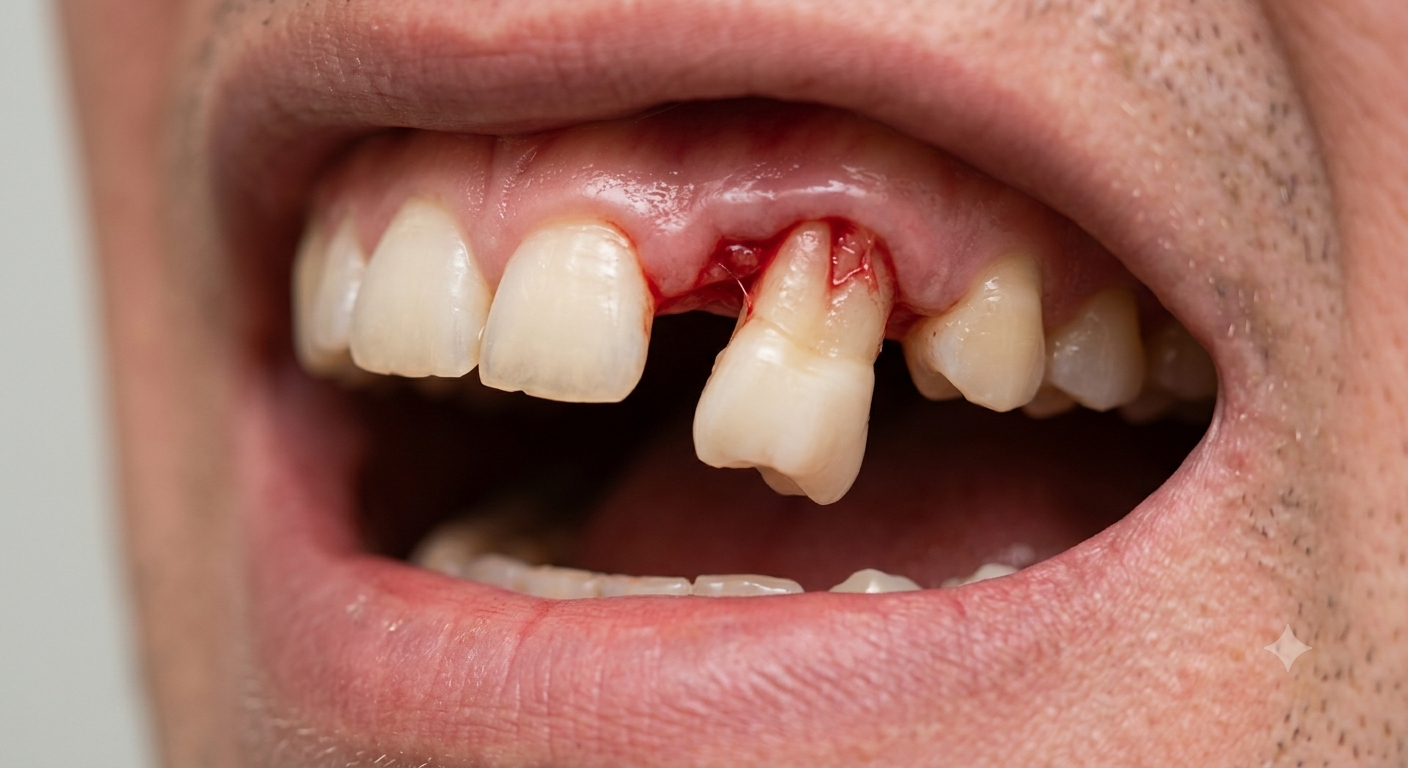
Quick answer: Subluxation is loose but in place. Extrusion is hanging lower or looking longer than the teeth beside it. Lateral luxation is pushed sideways, usually backwards toward the tongue.
A quick self-check: close your teeth together slowly. If one tooth touches before all the others, it has moved. That single test catches most extrusions and lateral luxations.
Do not tap on the tooth to test it, and do not push on it with your tongue to see how far it goes.
Extrusion vs. Lateral Luxation: Why the Difference Matters
Quick answer: An extruded tooth has been pulled partly out of its socket and usually slides back with gentle pressure. A laterally luxated tooth has been driven sideways and is wedged in fractured bone, which is why it must never be forced back at home.
This is the comparison that decides whether a tooth is salvageable or badly damaged by a well-meant rescue attempt.
If the tooth will not move with the very lightest pressure, that is your answer. Stop, and let it be repositioned properly with the area numbed.
What Should I Do at Home Before My Appointment?
Quick answer: Keep the tooth completely undisturbed, eat only soft or liquid food, apply a cold compress to the outside of the cheek, and sleep with your head raised. Do not test the tooth's movement
Two of these deserve a word of explanation.
Sleeping elevated reduces blood pressure at the injury site overnight, which cuts both the throbbing and the morning swelling. Two or three pillows is enough.
Not wiggling it is harder than it sounds. The urge to keep checking is almost universal, and it is the thing that most reliably converts a tooth we could have saved into one we cannot. The ligament reattaches in fibres a fraction of a millimetre thick. Every check breaks them.
Why Can't I Just Push It Back Into Place Myself?
Quick answer: A sideways-displaced tooth is usually wedged into a fractured socket wall. Forcing it against that bony lock can snap the root, drive bone fragments into the gum, or push the root tip further out through the bone plate.
With an extruded tooth — one hanging lower than its neighbours — very light pressure back into the socket is reasonable if it moves easily. Do not force it, and stop the moment you meet resistance.
With a lateral luxation, the situation is entirely different. The tooth has punched through the thin plate of bone at the front or back of the socket and is now pinned there.
Repositioning it properly requires three things you do not have at home:
- Local anaesthetic, because unlocking a wedged tooth is genuinely painful.
- A disengagement technique — the tooth has to be eased out of the bony lock before it can be moved back, not simply shoved sideways.
- An X-ray, to confirm the root is intact and to see exactly where the bone has broken.
Dr. Tarsem Lal, DDS repositions and stabilises displaced teeth regularly at the Norwood Park Boulevard office, and patients from Mueller and Windsor Park are often here within fifteen minutes of calling. That is comfortably inside the window that matters.
What Happens at the Office?
Quick answer: We take an X-ray, numb the area, ease the tooth back into its correct position, and bond a thin flexible splint to the neighbouring teeth. The splint stays on for two to four weeks depending on the injury.
The splint is deliberately flexible, not rigid. A small amount of natural movement helps the ligament heal properly; locking the tooth solid can cause the root to fuse to the bone.
Those later appointments are not routine box-ticking. They exist because the nerve inside a displaced tooth can die silently months after the injury, and catching that early means a straightforward root canal rather than an abscess. A tooth that also chipped or fractured in the same impact may need cracked tooth repair once it has stabilised.
Frequently Asked Questions
Will a loose adult tooth tighten back up on its own? Sometimes, but only if the ligament is held still in the right position while it heals. Left untreated and unsplinted, a loose adult tooth more often stays mobile or is eventually lost.
How long do I have before it's too late? Aim to be seen within 24 hours, and the same day if the tooth has visibly moved. Repositioning becomes harder and less predictable once a blood clot has begun to organise in the socket.
Does a loose tooth after an injury always need a splint? No. A tooth that is loosened but still in its correct position often needs only a soft diet and monitoring. Displaced teeth almost always need splinting.
Can I eat with a loose tooth? Yes, but only soft or liquid food, chewed entirely on the other side. Soup, yogurt, smoothies, scrambled eggs, and mashed potatoes are all fine for the first week.
Why does my bite feel wrong now? That usually means the tooth has shifted position, even slightly. It is a strong sign of extrusion or lateral luxation rather than simple loosening, and it needs same-day assessment.
My tooth is loose but it doesn't hurt. Do I still need to come in? Yes. Adrenaline suppresses pain for hours after an injury, and the ligament and bone damage is under the gum where you cannot see or feel it.
Will I need a root canal? Not always, but the risk rises with the severity of displacement. We monitor the nerve at each follow-up visit and only treat if it shows signs of dying.
Can a splint be put on the same day? Yes. Repositioning and splinting are normally completed in a single visit lasting under an hour.
Will the splint be visible? Barely. It is a thin wire or composite line bonded to the back of the teeth, which most people cannot see in normal conversation.
How do I brush with a splint on? Use a soft brush on all surfaces, gently, and add the antiseptic rinse we give you. Keeping the gumline clean genuinely improves how well the ligament heals.
What if my child's tooth is loose after a fall? Call us and tell us your child's age. The rules differ significantly between baby teeth and permanent teeth, and we will want to know which one is involved before you arrive.
Do you see patients outside Austin? Yes. We treat patients from Round Rock, Cedar Park, Georgetown, Leander, Kyle, Buda, Lakeway, Bee Cave, West Lake Hills, Hutto, Manor, Dripping Springs, Del Valle, Elgin, and Liberty Hill, and we are open Monday, Friday, Saturday, and Sunday, 8am to 8pm.
Call Today, Even If It Barely Hurts
A tooth that is loose or out of line after an injury is one of the few dental problems where doing nothing is actively harmful. Every hour it stays unsupported, and every time it gets tested, the ligament trying to reattach is torn again.
Leave the tooth alone. Eat soft. Keep your head raised. And call us today.
Call (512) 961-6200 and come to 1030 Norwood Park Blvd #324, Austin, TX 78753. We are open Monday, Friday, Saturday, and Sunday, 8am to 8pm, and we keep emergency dentistry slots open for dental trauma every day we are open.
Mild pain is not a reason to wait. It is just what a fresh injury feels like before the adrenaline wears off.
Read More
.jpg)
Emergency Tooth Extraction Cost in Austin, TX
.jpg)
Infected Tooth: Root Canal or Extraction in Austin, TX?
Read more.jpg)
Tooth Extraction on Blood Thinners: Austin, TX Guide
Read moreDon't Wait Out the Pain
